
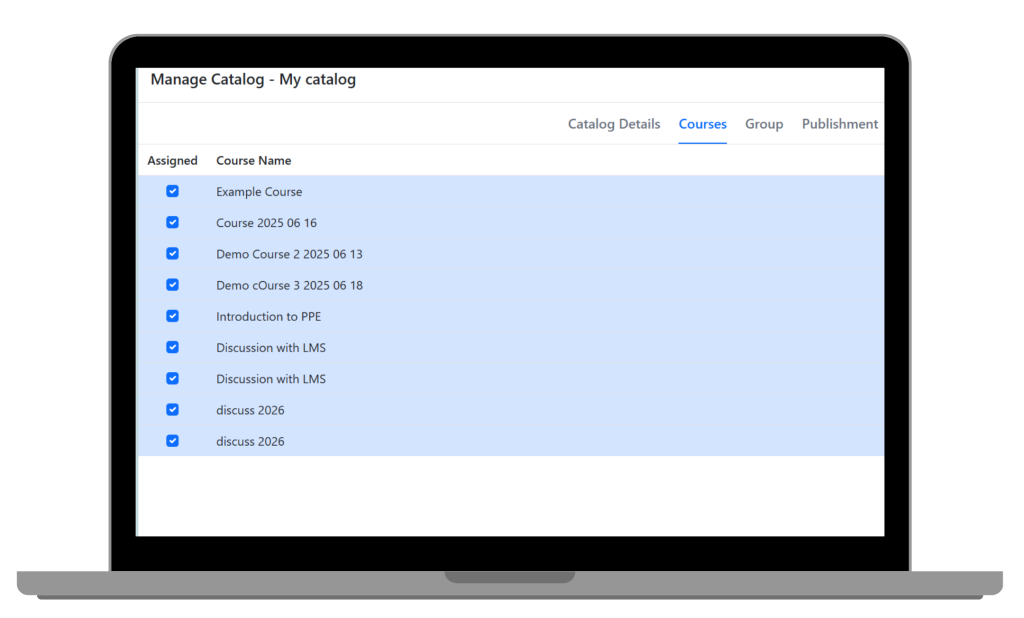

Centralized control allows the management to address the process in a fast-paced way.

By archiving irrelevant catalog, the catalog feature helps users focus on current, required training without being distracted by obsolete content.
When a catalog is archived, its completion of data and associated records stay preserved in the system for audit and compliance purposes, ensuring critical training history is never lost.

Only users with appropriate permissions can archive or restore catalog, safeguarding the integrity of the training program.

CloudSDS LMS supports continuous updates to compliance training by allowing rapid changes to courses in response to evolving OSHA, GHS, and other regulatory requirements.

Archived courses retain completion and training history, supporting audit trails that demonstrate compliance activities to regulatory bodies.
Courses that have become outdated or non-compliant due to regulatory changes can be quickly archived. This prevents learners from accessing obsolete training while keeping historical records intact for audit and compliance verification.

The platform can send notifications to administrators or learners when training updates or reassignments are required due to regulatory changes.
The LMS provides a centralized training library that makes it easy for administrators to manage course lifecycle—publishing new compliant versions and archiving old ones—ensuring the training catalog remains accurate and focused on current regulatory demands.

CloudSDS LMS specifically emphasizes safety and compliance training and offers features tailored to manage and adapt to hazardous materials regulations and workplace safety standards effectively.
Our LMS acts as a single platform to upload new versions of SOP or hazard modules and retire older versions. This centralization ensures employees always access the latest, compliant procedures.
New SOPs are often converted into engaging digital formats, such as videos, interactive quizzes, or simulations, improving understanding and retention over traditional documents.

Older modules are archived but remain accessible for historical audit purposes. The system clearly marks the active, current version to avoid confusion.
Updated modules can be assigned based on departments, roles, or job functions, ensuring targeted delivery of relevant SOP and hazard training.
When an updated module is published, the LMS can automatically notify relevant employees, require completion of refresher training, and track progress.

This streamlined approach reduces risks related to outdated procedures, enhances workforce safety, and supports audit readiness by keeping training current with OSHA, GHS, and industry standards.
All training content is controlled in one place to maintain accuracy and compliance across the entire training library, minimizing risks of outdated or non-compliant materials.
Outdated or non-compliant courses are archived while updated versions replace them, preventing training gaps and supporting audit readiness.
Courses can be automatically assigned and scheduled based on roles, departments, and regulatory needs to ensure that employees receive mandatory training on time.
The LMS provides detailed reports and tracking to verify compliance with legal obligations, useful for internal reviews and external regulatory audits.
Training is tailored by job role and regulatory relevance, ensuring the workforce completes only the necessary compliance training but doesn’t miss critical updates.
The platform supports ongoing updates as regulations evolve, allowing organizations to quickly modify training content to stay current with OSHA, GHS, and industry changes.

CloudSDS LMS offers a Custom Course Lifecycle Management feature that allows administrators to control the entire lifecycle of each training module. This includes the ability to set start dates and expiration dates for courses, enabling precise management of when courses are available to learners and when they are archived or retired. This functionality helps ensure that training content stays current and compliance requirements are met by removing outdated courses automatically.
CloudSDS LMS offers the ability to archive old versions of courses while preserving learner completion records. When courses are archived, they become read-only and are no longer available for active enrollment or content updates, but all historical learner data, including completions and certifications tied to those course versions, remain intact and accessible for reporting purposes. This ensures compliance recordkeeping is uninterrupted even as course content evolves.

CloudSDS LMS supports Custom Course Lifecycle Management, which includes the ability to schedule content reviews and updates for each training module. This allows administrators to set planned review dates to ensure that course content remains current and compliant with evolving EHS standards and regulations. Scheduled reviews prompt content owners or administrators to revisit training materials, update information, and republish courses as needed.

CloudSDS LMS supports the ability to reactivate archived courses for purposes such as re-training or audits. When a course is archived, it is removed from the active catalog but remains stored with learner completion and engagement data intact. Administrators can easily restore or reactivate these courses, making them available again to learners without losing historical records.

Smart course management with CloudSDS improves EHS outcomes by ensuring only current, approved training is in use, which reduces confusion, improves clarity, and ensures safety readiness. This is accomplished by maintaining a tightly controlled course catalog where outdated or unapproved training is archived or removed automatically, and only the latest, compliant content is accessible to learners.
Smart course management in our LMS helps minimize audit and legal risks from outdated materials by ensuring that only the most current and approved training content is available for use. This is critical in maintaining compliance with evolving regulations and standards, thereby reducing the risk of penalties, fines, or legal exposure during audits.

Our LMS improves EHS outcomes by simplifying content discovery and assignment through its smart Catalog feature. It provides intuitive filtering and robust search capabilities, allowing users to quickly find courses by categories, job roles, compliance requirements, or training status. This eliminates confusion and reduces time spent searching, making it easy for administrators to locate and assign the right training.

CloudSDS LMS supports continuous learning and SOP evolution by enabling ongoing updates and refinements to training content aligned with evolving safety procedures and organizational needs. The platform facilitates a culture of continuous learning by allowing scheduled content reviews, easy updates, and version management, ensuring training materials remain current.